HIFI supports real-time payments
Real-time payments are instant, irrevocable bank-to-bank transfers that settle the moment they clear.
In the US, two networks enable this: RTP, operated by The Clearing House, and FedNow, operated by the Federal Reserve. HIFI supports both.
Unlike ACH, which batches and settles on a schedule, real-time payments process and finalize immediately. They support both credit push payments and request-for-payment flows, and run on ISO 20022 messaging for richer transaction data.
In short: real-time payments enable instant settlement and finality for domestic transfers.
What Real-Time Payments + HIFI Enables
For businesses moving money through HIFI, real-time payments open up a fast, low-cost US rail alongside our existing bank and blockchain infrastructure. Developers can use real-time payments for both inflows and outflows:
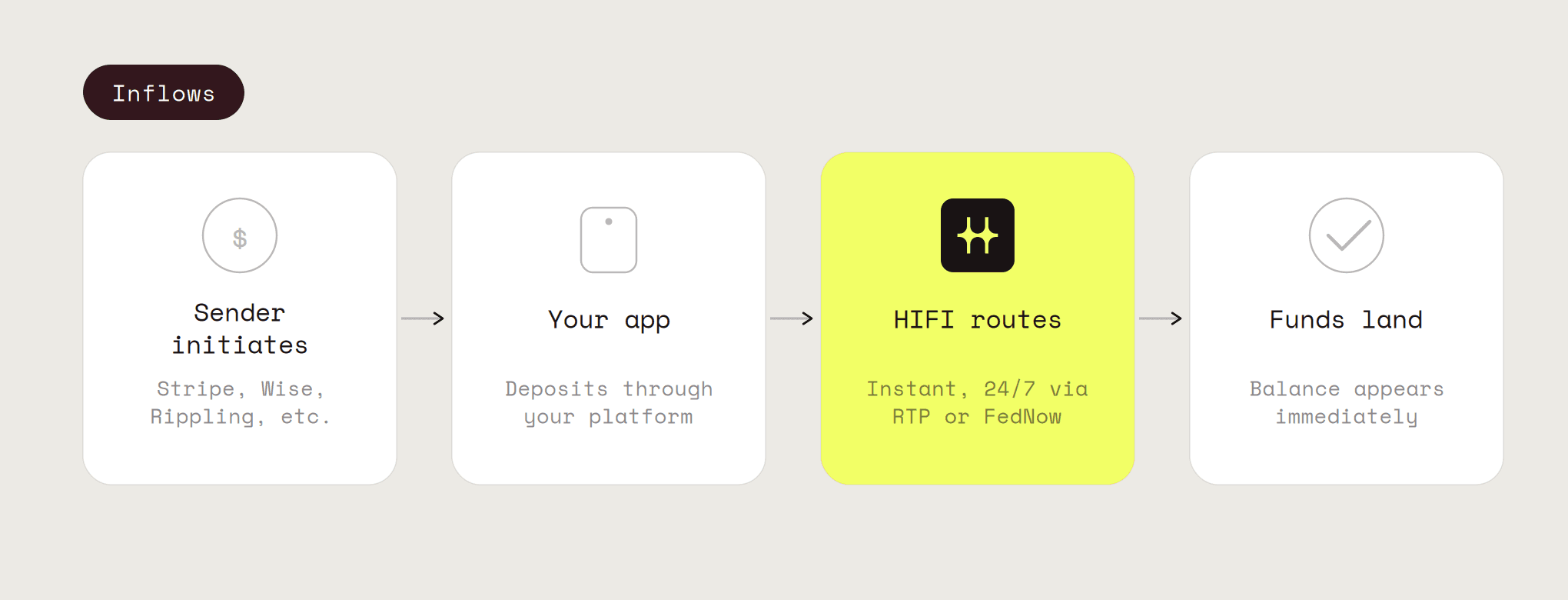
Inflows — Fund accounts or receive payments instantly from any bank connected to RTP or FedNow. A platform user looking to fund their HIFI-powered wallet sends money via Stripe, Wise, Rippling, or any RTP or FedNow-enabled sender and the balance lands immediately.
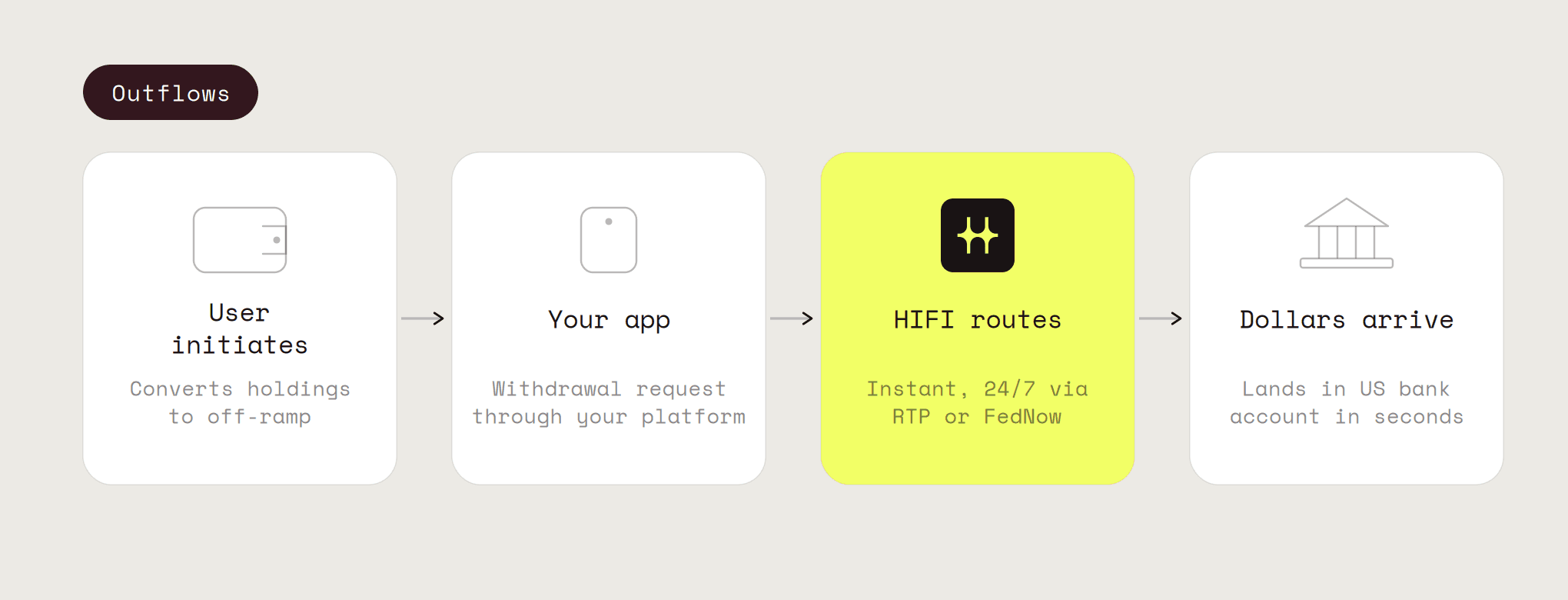
Outflows — off-ramp through HIFI and land funds in a US bank account in real time via real-time payment. A user looking to move funds off-chain and into their bank account converts their holdings and the dollars arrive in seconds.
Real-Time Payments in Practice
Things to keep in mind when implementing real-time payments:
- Push-only. Real-time payments only support sender initiated transactions. This makes it complementary to, not a replacement for, use cases that rely on debits like recurring billing or loan payments.
- US-only availability. Real-time payments are domestic rails, so funds need to be in a US account before they can move. The majority of US demand deposit accounts are reachable via real-time payments, but gaps remain among smaller banks and credit unions.
- Irrevocable. Real-time payments are irreversible. This is both a feature for recipients (guaranteed good funds), and a tradeoff for senders (errors can't be undone).
Given these constraints, redundancy is particularly important with real-time payments. HIFI's support for ACH, wire, SWIFT, and onchain rails gives developers the flexibility to match the right rail to the right flow.
FAQs
What's the difference between RTP and FedNow?
RTP is operated by The Clearing House and FedNow is operated by the Federal Reserve; HIFI supports both networks.
How do real-time payments differ from ACH?
ACH batches and settles on a schedule. Real-time payments process and finalize immediately, supporting both credit push payments and request-for-payment flows on ISO 20022 messaging for richer transaction data.
Can real-time payments be used to pull funds, like for recurring billing?
No. Real-time payments are push-only, supporting only sender-initiated transactions, which makes them complementary to use cases that rely on debits like recurring billing or loan payments.
Are real-time payments available outside the US?
No. But real-time payments are often the first leg of a payment that routes elsewhere. RTP and FedNow only move funds between US bank accounts, so the transfer itself stays on domestic rails, but on HIFI that US leg can fund a virtual account held by a counterparty anywhere in the world.
What can developers use HIFI's real-time payments support for?
Developers can use it for both inflows, funding accounts or receiving payments instantly from any RTP or FedNow-enabled sender, and outflows, off-ramping stablecoin holdings into a US bank account in seconds.
