How Ourbit converted its USDT treasury to USDG through HIFI
Ourbit is a new-generation centralized exchange founded in 2024 by industry veterans from a top-tier exchange. Serving over one million users across more than 100 countries, the platform grew quickly into one of the most active retail trading destinations in crypto.
By early 2025, Ourbit had climbed into the top 30 global exchanges on both CoinMarketCap and CoinGecko, with daily spot volume exceeding $2 billion and futures volume topping $9 billion. Ourbit built its reputation on speed: early listings, deep liquidity, and a community-first approach to retail trading.
As volume scaled and the platform broadened its product offerings across asset classes, the demands on its stablecoin infrastructure grew with it.
The move to USDG
In 2025, Ourbit decided to change how it holds and manages stablecoins by moving its treasury from USDT to USDG.
Like most exchanges worldwide, Ourbit denominated its order books, settled trades, and held reserves in USDT. With a $184B+ market cap and daily volume exceeding $60 billion, USDT is the de facto standard.
Drawn by the Global Dollar Network's rewards program and USDG's regulatory footprint across Singapore and the EU, Ourbit made the switch to USDG.
Issued by Paxos, USDG operates under dual regulatory oversight from MAS in Singapore and MiCA-compliant entities in the EU. Fully bankruptcy-remote, USDG reserves are held at DBS, Southeast Asia's largest bank alongside European banking partners under MiCA oversight.
As a Global Dollar Network member, Ourbit receives rewards on its USDG holdings, which it passes back to its users. Rewards create a stickier product and give users a reason to hold funds on the exchange rather than convert or offramp.
“We're seeing more exchanges use USDG not just as a treasury asset, but as infrastructure for the products they're building for users.”
Peter Jonas Chief Revenue Officer, Paxos
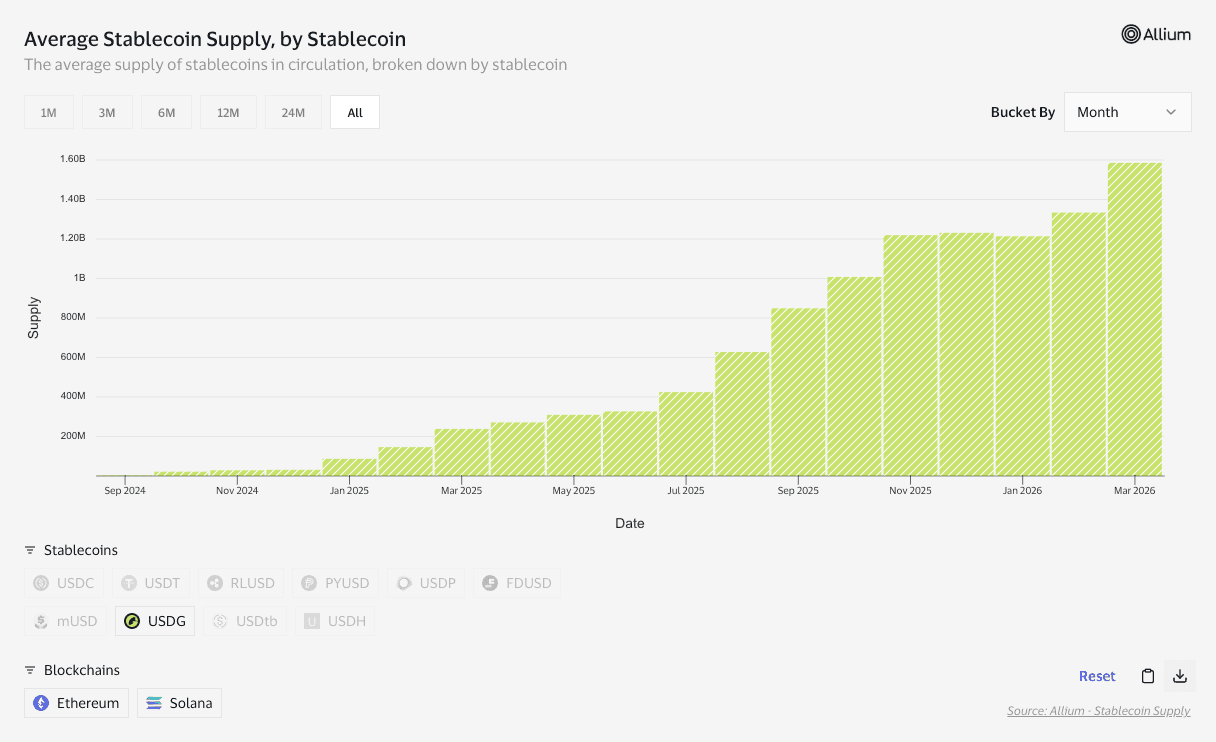
Total supply of USDG has grown over 550% in the past year.
The liquidity gap
The conversion path from USDT to USDG doesn't exist as a simple trade. No single pool has the depth to handle a clip of this size cleanly, and executing on the open market would mean fragmented fills, slippage, and real value lost on a transaction that's supposed to be one-to-one.
The right path would require routing through two liquidity sources: USDT to USDC across deep orderbooks, then USDC to USDG. Given its own onchain teams and DeFi funds, Ourbit is quite familiar with navigating onchain liquidity. But for a bespoke infrastructure problem, the sophisticated operator see value in a trustworthy, cost-effective, purpose-built solution.
“When you're managing transactions at this scale, security and stability are the only things that matter. It felt like the right balance for diversifying our risk.”
Jim Yau Co-Founder, Ourbit
The conversion pipeline
Working alongside Paxos, HIFI built an automated conversion pipeline for exactly this purpose. HIFI's two-hop routing handles the full conversion at five basis points, competitive pricing for a transaction that previously had no clean path at institutional size.
For Ourbit, the result was exactly what it needed: no manual coordination, no new custodial relationships to stand up, no fragmented execution. One pipeline, one integration, handled end to end.
“It's been very seamless and largely hands-off. The capital stays in our accounts and does its thing.”
Jim Yau Co-Founder, Ourbit
Ourbit's treasury is now held in a dual-regulated, bankruptcy-remote asset. It generates rewards the exchange passes through entirely to its users, a direct addition to the value Ourbit offers its community with no added operational overhead.
“Look for partners with a strong regulatory track record. Diversifying your treasury through a solid protocol is a smart, strategic move for long-term stability.”
Jim Yau Co-Founder, Ourbit
What comes next
Beyond the treasury operations, Ourbit has begun deploying USDG across trading pairs on the platform, integrating it into the exchange's core product. BTC, ETH, and SOL pairs against USDG are live on the exchange today, and Ourbit is evaluating USDG-based perpetuals and earn products as natural extensions.
Working with Paxos, HIFI built stablecoin conversion infrastructure for exactly this use case. Ourbit was the first exchange to use it. The pipeline is now live and available to any exchange or fintech looking to move large stablecoin positions at competitive pricing.
→ Learn more: https://app.hifi.com/request-access
FAQs
What is Ourbit?
Ourbit is a centralized exchange founded in 2024 that serves over one million users across 100+ countries. By 2025, Ourbit had exceeded daily spot volume of $2 billion and futures volume of $9 billion, and been named the top 30 global exchanges on CoinMarketCap and CoinGecko.
Why did Ourbit move its treasury from USDT to USDG?
Ourbit moved its treasury to USDG in 2025 because of the Global Dollar Network’s strong reward program and USDG’s regulatory footprint across Singapore and the EU.
What is USDG?
USDG is a stablecoin issued by Paxos. It operates under dual regulatory oversight from the Monetary Authority of Singapore and MiCa-compliant entities in the EU. USDG is fully bankruptcy-remote and reserves are held at DBS, Southeast Asia's largest bank, alongside European banking partners under MiCA oversight.
Why couldn't Ourbit convert USDT to USDG through a single trade?
A single liquidity pool does not have enough depth to handle a treasury-sized USDT-to-USDG conversion. Executing on the open market would result in fragmented fills, slippage, and lost value on transactions, so the conversion has to route through two liquidity sources instead from USDT to USDC, then USDC to USDG.
What did HIFI build for Ourbit?
HIFI, working alongside Paxos, built an automated two-hop conversion pipeline that routes USDT to USDC and then USDC to USDG, handling the full conversion end to end.
Can other exchanges use HIFI's USDT-to-USDG conversion pipeline?
Yes. The pipeline HIFI built is live and available to any exchange or fintech looking to move large stablecoin positions at competitive pricing.
What other stablecoins does HIFI support minting and redeeming, beyond the USDT-to-USDG pipeline built for Ourbit?
HIFI supports direct mint and redeem across USDC, USDG, PYUSD, and RLUSD.
